
Encapsulation
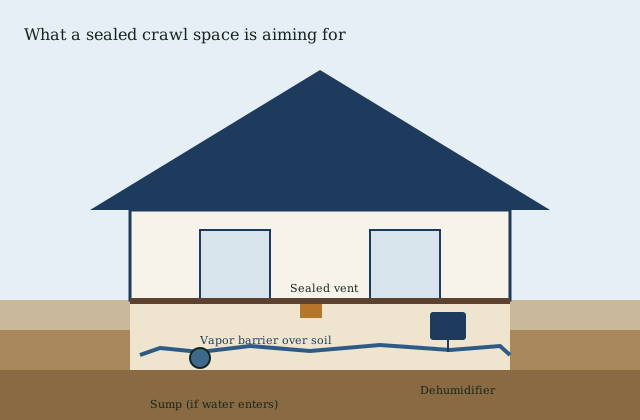
Lining the ground and walls, sealing vents, and drying the air so the space stops feeding moisture into the house.
Read the encapsulation guideMemphis · Shelby County · DeSoto County
A damp, musty crawl space is common in the Mid-South. Tell us what you are seeing under the house and we will match you with an independent crawl space contractor who works in Memphis and North Mississippi. The guides on this site explain the options first, so you know what to ask when they call.
Memphis Crawl Space is a referral and matching service. We are not a contractor, we hold no contractor license, and we do not inspect or repair crawl spaces ourselves. When you send a request, we pass your details to an independent crawl space contractor who works in the Memphis and DeSoto County area. That contractor contacts you, does any inspection, and gives you their own price.
You talk to one contractor at a time, not a crowd of callers.
A smell in the hallway, puddles after a storm, a floor that dips by the bathroom, or a home inspection report that flagged the crawl space.
Your request goes to an independent crawl space contractor who serves your part of the metro. They call to set up a visit.
The contractor goes under the house, shows you what they found, and gives you a written quote. Whether you hire them is up to you.
Start with the weather. The National Weather Service's 1991–2020 normals for Memphis International Airport show about 55 inches of precipitation a year (54.94 inches), with March and April the wettest months at close to six inches each. July afternoons average about 92°F. That combination of heavy spring rain and long, muggy summers puts a steady load of moisture on any house built over open ground.
Then look at the ground itself. U.S. Geological Survey mapping describes the uplands where most of the metro is built as loess: windblown silt laid down during the last ice age, roughly 15 to 50 feet thick, deepest near the Mississippi River bluffs and thinner to the east. When loess weathers it turns into a clayey silt or silty clay. Soil like that sheds water slowly, so a yard that slopes toward the house, or a downspout that empties at the foundation, can keep the dirt under a home wet long after the rain stops. Lower ground along the Wolf River, the Loosahatchie River, and Nonconnah Creek sits on floodplain deposits where water has even less reason to leave.
Many older homes were also built with foundation vents that pull outside air under the floor. In a Memphis summer that air is warm and wet. When it hits cooler ductwork, pipes, and joists, water condenses on them. Over years you get rusty duct straps, sagging insulation, and dark staining on the wood.
None of this means every house needs a sealed crawl space. It means a good inspection should sort out where the water comes from: liquid water after storms, vapor coming up out of the soil, or humid air coming in through vents. Each one has a different fix, and a contractor should be able to tell you which applies to your house.
Sources: NWS Memphis climate normals; USGS, Surficial geologic map of the Southwest Memphis Quadrangle; USGS, Water-Resources Investigations Report 4-76.
Each guide explains what the work is, when it makes sense, and what belongs in a quote.
Lining the ground and walls, sealing vents, and drying the air so the space stops feeding moisture into the house.
Read the encapsulation guideSoft or cracked joists, sinking piers, and floors that bounce or slope.
Read the repair guideGutters, grading, interior drain lines, and sump pumps for crawl spaces that flood.
Read the drainage guideThe plastic on the ground: what thickness means, and why a torn sheet does little.
Read the vapor barrier guideWhen a crawl space dehumidifier earns its keep, and where the water it collects should go.
Read the dehumidifier guideWhat dark spots on wood usually mean and what an inspection can and cannot tell you.
Read the moisture guideShelby County, Tennessee and DeSoto County, Mississippi. Each page covers that town specifically.
Midtown, East Memphis, Whitehaven, Raleigh and the rest of the city.
Established suburban streets with mature trees and wooded lots near the Wolf River.
A historic town square ringed by decades of newer subdivisions.
Northeast of Memphis, with a broad mix of ranch and two-story homes.
Eastern Shelby County subdivisions, much of it now inside Memphis city limits.
DeSoto County's largest city, just over the state line from Whitehaven.
Fast growth east of I-269, from older lots to brand-new streets.
The DeSoto County seat, with an older core and rural edges.
West DeSoto neighborhoods between Southaven and the Mississippi River lowlands.
A price given over the phone or from the driveway is a guess. Before you compare numbers, make sure the contractor actually went under the house and can answer these questions:
Ask for photos and a written scope. If two quotes are thousands of dollars apart, the scopes are usually different, so compare them line by line.
No. We match you with an independent local contractor. They do the inspection, the quote, and any work you hire them for.
We have not surveyed local invoices. Angi's 2026 national guide puts the average at $5,500, with most jobs between $5,000 and $15,000. See the cost guide.
Yes. We take requests from DeSoto County, including Southaven, Olive Branch, Hernando, and Horn Lake.
Send one short request and we will pass it to an independent crawl space contractor who covers Memphis and DeSoto County.
Memphis Crawl Space is a referral and matching service. We are not a contractor, we hold no contractor license, and we do not inspect or repair crawl spaces ourselves. When you send a request, we pass your details to an independent crawl space contractor who works in the Memphis and DeSoto County area. That contractor contacts you, does any inspection, and gives you their own price.